

The Project Management Institute (PMI) reports that organizations with mature project management practices complete more projects on time and within budget than those relying on less structured approaches. As energy infrastructure projects become larger, more complex, and more geographically dispersed, digital project management tools are playing a growing role in helping teams coordinate work, manage risks, and improve decision-making throughout the project lifecycle.
Large-scale developments in sectors such as oil and gas, liquefied natural gas (LNG), power generation, renewable energy, and industrial infrastructure involve thousands of moving parts. Engineering teams, contractors, suppliers, regulators, and stakeholders must remain aligned despite changing conditions and tight schedules. Industry resources such as Gary and Scott’s electrical team highlight how modern engineering and project management approaches are increasingly supported by digital platforms that centralize information and improve visibility across complex operations.
The Challenges of Managing Complex Infrastructure Projects
Energy infrastructure projects are among the most demanding construction and engineering initiatives in the world. A single facility may involve multiple contractors, specialized equipment suppliers, environmental compliance requirements, and extensive commissioning activities.
Traditional project management methods often depended on spreadsheets, email chains, paper-based documentation, and disconnected software systems. While these tools served their purpose for many years, they created several challenges:
- Difficulty tracking project progress in real time
- Version control issues with engineering documents
- Communication gaps between field and office teams
- Delays in identifying risks and schedule impacts
- Limited visibility into resource allocation and costs
Research from McKinsey & Company indicates that large capital projects frequently experience schedule overruns and budget increases, often due to coordination challenges, information silos, and changing project requirements. When teams lack access to current information, even small misunderstandings can create significant downstream consequences.
Electrical systems provide a useful example. Installation schedules, equipment deliveries, testing procedures, and commissioning activities must be carefully coordinated. If one team is working from outdated drawings, project delays and costly rework may follow.
The Growth of Digital Engineering Platforms
To address these challenges, organizations across the energy sector are adopting integrated digital engineering and project management platforms. These systems combine project scheduling, document control, workflow management, reporting, and collaboration tools into a unified environment.
Digital transformation has accelerated significantly over the past decade. Data from Deloitte shows that infrastructure organizations increasingly view digital technologies as essential for improving project performance and operational efficiency.
Modern platforms often include:
- Cloud-based document management
- Building Information Modeling (BIM)
- Digital engineering workflows
- Mobile field reporting applications
- Real-time project dashboards
- Integrated cost and schedule tracking
- Automated approval processes
These tools create a single source of truth where stakeholders can access current project information regardless of location. Engineers in design offices, construction supervisors in the field, and executive decision-makers can review the same data simultaneously.
Organizations such as Autodesk, Bentley Systems, and Oracle Construction and Engineering have developed specialized platforms that support infrastructure projects throughout planning, design, construction, and operations.
Benefits of Data-Driven Project Oversight
The greatest advantage of digital project management tools may be their ability to transform raw project information into actionable insights. Rather than reacting to problems after they occur, teams can identify potential issues earlier and respond more effectively.
Improved Visibility
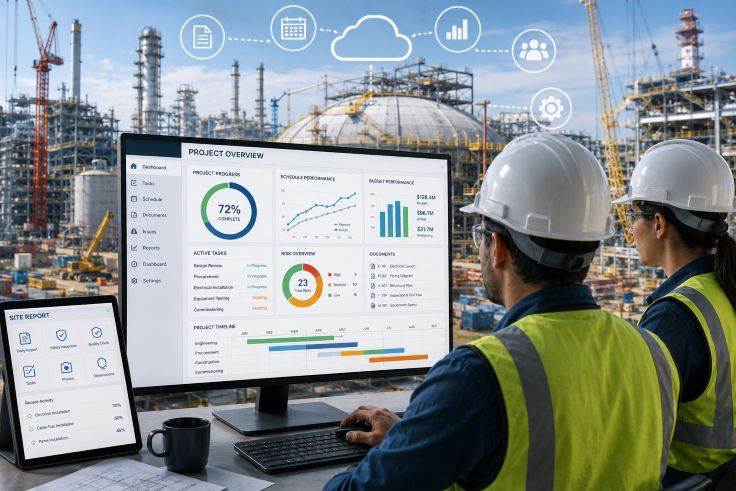
Project dashboards provide real-time snapshots of schedule performance, budget status, resource utilization, and risk indicators. Managers can quickly identify emerging concerns before they affect project milestones.
PwC notes that data-driven project management improves transparency and supports more informed decision-making across large organizations. Visibility becomes especially valuable when multiple contractors are working simultaneously across different locations.
Better Collaboration
Cloud-based systems allow teams to collaborate without relying solely on emails or manual updates. Engineering drawings, inspection reports, procurement records, and construction documentation remain accessible through centralized platforms.
This approach reduces misunderstandings and helps maintain alignment between project participants.
Enhanced Risk Management
Large infrastructure projects face risks ranging from supply chain disruptions to weather-related delays and regulatory changes. Digital tools help teams monitor risk indicators continuously and evaluate potential impacts.
Automated alerts and predictive analytics can highlight trends that might otherwise go unnoticed. Early detection allows project leaders to implement mitigation strategies before challenges become major problems.
More Accurate Reporting
Manual reporting often consumes significant administrative effort. Digital systems automate data collection and reporting processes, reducing errors while improving consistency.
Stakeholders receive timely information that supports planning, budgeting, and strategic decision-making.
Lessons for Electrical Contracting and Field Operations
While many discussions focus on billion-dollar infrastructure developments, the lessons apply equally to electrical contracting and field operations.
Electrical contractors frequently manage multiple crews, coordinate equipment deliveries, track inspections, and maintain compliance documentation. Digital project management tools help simplify these responsibilities.
Consider a field operation managing electrical installations across several industrial facilities. Project supervisors can use mobile applications to upload site photos, complete inspections, submit progress reports, and document safety observations directly from the field.
Information becomes immediately available to project managers and engineering teams, eliminating delays associated with paper-based reporting.
Teams similar to those represented by Gary and Scott’s electrical operations can benefit from:
- Digital work order management
- Real-time task tracking
- Centralized drawing repositories
- Mobile safety reporting
- Automated scheduling updates
- Electronic quality assurance documentation
These capabilities improve coordination between office personnel and field technicians while helping maintain project quality and safety standards.
Research published by Associated General Contractors of America (AGC) suggests that construction firms adopting digital technologies often report gains in productivity, communication, and project visibility. Although implementation requires investment and training, the long-term operational benefits can be significant.
Future Technology Trends in Energy and Construction
Digital project management continues to evolve alongside advances in artificial intelligence, automation, and connected infrastructure.
Several emerging trends are likely to shape future energy projects:
Artificial Intelligence and Predictive Analytics
AI-powered systems are increasingly capable of analyzing large volumes of project data to identify patterns, forecast delays, and support resource planning. Experts at Gartner note that predictive analytics will become more important as organizations seek greater operational efficiency.
Digital Twins
Digital twin technology creates virtual representations of physical assets. Project teams can simulate performance, evaluate scenarios, and optimize designs before construction activities begin.
The concept is gaining traction across power generation, industrial facilities, and energy infrastructure sectors.
Internet of Things (IoT) Integration
Connected sensors provide continuous streams of operational and construction data. These systems support equipment monitoring, asset management, and project oversight throughout an asset’s lifecycle.
Expanded Mobile Workforce Solutions
As field teams become increasingly mobile, organizations are investing in tools that provide seamless access to project information from any location. Real-time connectivity improves responsiveness and strengthens collaboration between project stakeholders.
READ ALSO: The Illuminating Partnership | How Technology is Revolutionizing the Lighting Store Experience
Conclusion
Managing modern energy infrastructure projects requires more than traditional scheduling and documentation methods. Growing project complexity, larger stakeholder networks, and increasing demands for efficiency have accelerated the adoption of digital project management platforms throughout the energy and construction sectors.
By improving visibility, strengthening collaboration, enhancing risk management, and supporting data-driven decision-making, these technologies help organizations address long-standing project delivery challenges. Lessons learned from large-scale infrastructure programs are increasingly influencing electrical contracting, field operations, and industrial construction practices as well.
As artificial intelligence, digital twins, predictive analytics, and connected technologies continue to mature, digital project oversight will likely become an even more important component of successful engineering and construction execution. Organizations that embrace these tools will be better positioned to navigate the complexity of future energy and infrastructure development projects.
 Global smart home adoption continues to grow, and smart locks are becoming one of the most common upgrades for residential security. Data from Grand View Research indicates that the smart lock market continues expanding as homeowners look for keyless access, remote management, and connected home features. Convenience often drives the decision. People like the ability to unlock doors with phones, assign temporary access codes, and monitor entry activity from anywhere.